First Time at the Driving Range - The New Golfer Starter Series Lesson #4
Going to a driving range for the first time can feel a little intimidating.
You might be wondering:
- Where do I go when I arrive?
- Do I need my own golf clubs?
- Which club should I use?
- How many golf balls should I buy?
- What if I can barely hit the ball?
- Will everyone else be watching me?
The good news is that the driving range is probably one of the best places to start golf.
You don't need to know how to play a golf course.
You don't need a perfect golf swing.
And you definitely don't need to hit every ball well.
Your only job on your first visit is to get comfortable hitting some golf balls and enjoy the experience.

1. What Is a Driving Range?
A driving range is simply a place where golfers practice hitting golf balls.
Instead of playing an entire golf hole, you stand in your own hitting area — usually called a bay — and hit balls out into a large open field.
Most ranges have distance markers or targets to aim at.
Some have grass hitting areas.
Others use artificial mats.
For a beginner, either is perfectly fine.

2. What Should You Bring?
You don't need much.
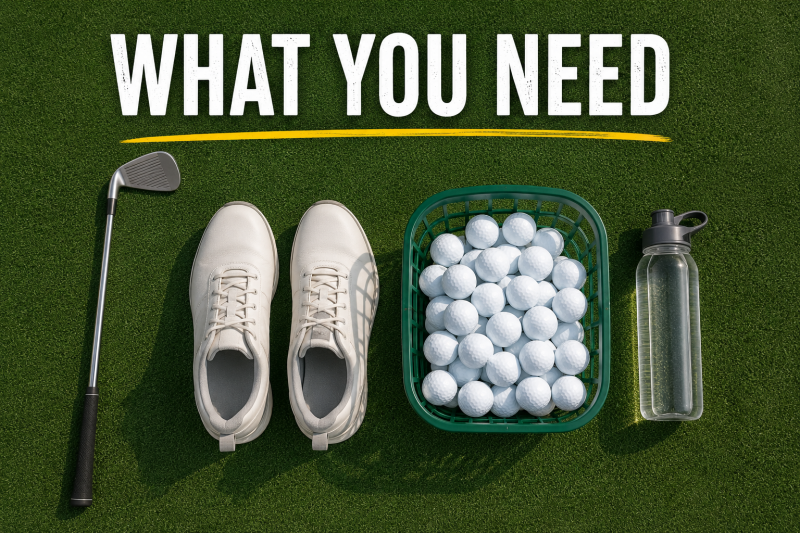
For your first visit, you really only need:
✓ Comfortable clothes
✓ Comfortable shoes
✓ A golf club or two
✓ A little patience
Many driving ranges also allow you to hire or borrow golf clubs, so don't worry if you don't own a set yet (but check first online)
You also normally buy the golf balls at the range.
3. What Happens When You Arrive?
This is probably the part new golfers worry about most. But the process is normally very straightforward.
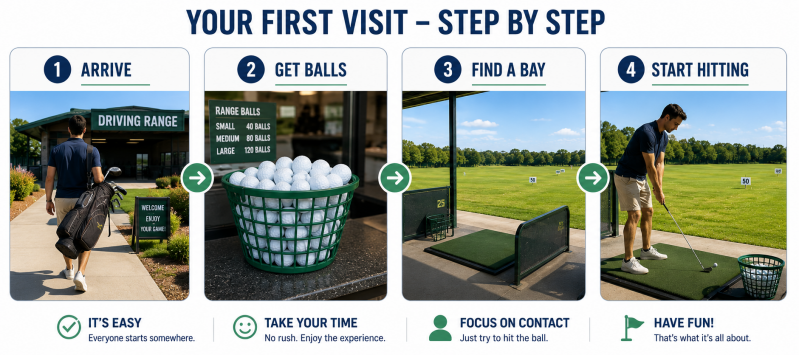
You arrive at the range and go to the reception area, pro shop or ball machine.
Tell them you would like some range balls. If you need a club, ask whether they have clubs available to hire or borrow.
You'll then receive either:
A basket of golf balls
or
A code/card that releases balls from a machine.
Take the balls to an available hitting bay.
That's basically it.
4. Which Golf Club Should You Start With?
Don't begin by trying every club in the bag.
And you don't need to immediately pull out the driver.
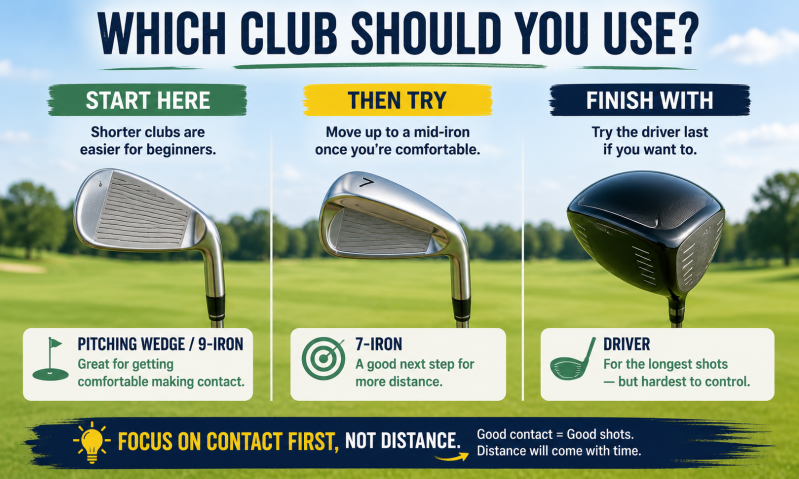
For your first few shots, use a shorter club such as a 9-iron or pitching wedge.
Short clubs are generally easier for beginners to control.
Once you're comfortable making contact, try something slightly longer such as a:
7-iron
Then, if you want, finish with a few shots using a:
Driver
But don't judge your first range session by how far you hit the driver.
Making reasonably solid contact is far more important.
5. Start With Small Swings
One of the biggest mistakes beginners make is trying to hit the golf ball as hard as possible.
You don't need to.
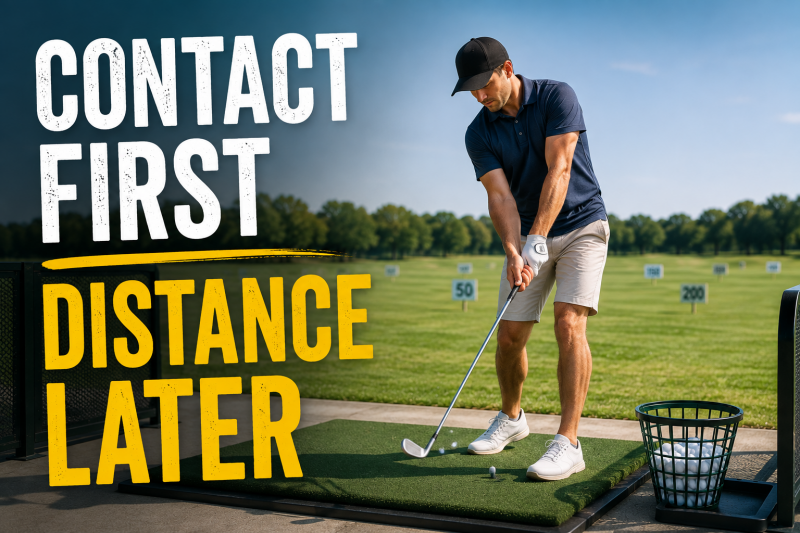
Start with a few relaxed half-swings.
Try simply to make contact with the ball.
Once that feels comfortable, gradually make a slightly bigger swing.
Think:
CONTACT FIRST. DISTANCE LATER.
6. Don't Worry About Where Every Ball Goes
Some shots might fly straight.
Some might go left.
Some might go right.
And occasionally you might barely move the ball at all.
That's completely normal when you're learning.
Your first visit isn't a test.
You're simply getting used to:
holding the club,
standing over the ball,
making a swing,
and hitting something.
You can work on accuracy later.

7. How Many Balls Should You Hit?
You don't need to hit hundreds.
For a complete beginner, somewhere around 40–60 balls is plenty for a first session.
Take your time between shots.
There is no prize for finishing the bucket first.
A simple first session could look like:
10 balls — small swings
20 balls — wedge or 9-iron
15 balls — 7-iron
5–10 balls — driver if you want to try it
The exact numbers don't matter.
The important part is avoiding the temptation to machine-gun golf balls one after another.

8. Basic Driving Range Safety
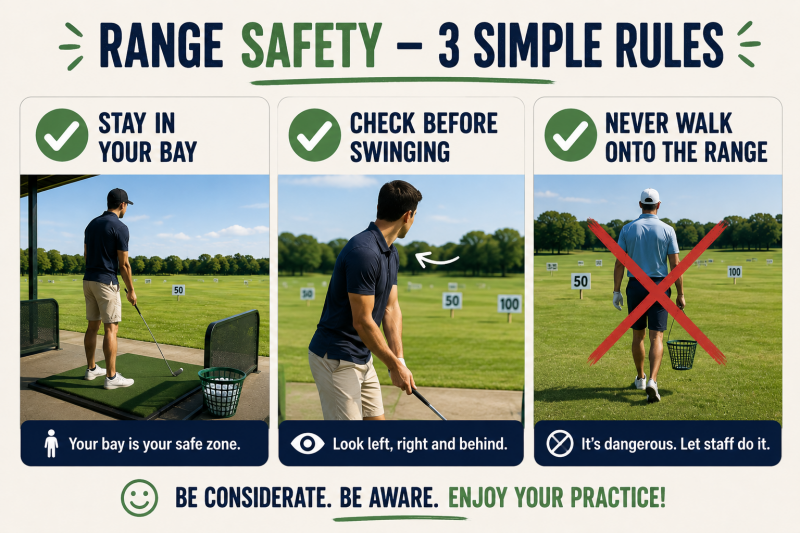
There are only a few important things to remember.
Stay inside your hitting bay.
Only swing when nobody is standing close enough to be hit by your club.
Never walk onto the driving range to retrieve a golf ball.
Keep children and other people clear while you swing.
And pay attention to any instructions or signs at the range.
You don't need to know complicated golf etiquette yet.
Just be aware of the people around you.
9. Is Everyone Watching You?
Probably not.
Most golfers at the driving range are concentrating on their own game.
Golfers hit bad shots at driving ranges every day — including very experienced golfers.
You don't need to look like a golfer.
You don't need an expensive golf bag.
And nobody expects a beginner to hit perfect shots.
The range exists for practising.
That's why everyone is there.

Your First Driving Range Checklist
Before finishing the page, I'd have one highly visual checklist.
BEFORE YOU GO
✓ Wear comfortable clothes
✓ Check whether the range hires clubs
✓ Buy a small or medium bucket of balls
✓ Start with a short iron
✓ Begin with easy swings
✓ Focus on contact rather than distance
✓ Don't worry about bad shots
✓ Have fun
That's Your First Driving Range Visit Done
You don't need to learn everything about golf before visiting a driving range.
In fact, the range is where you can start figuring golf out.
Hit some balls.
See how it feels.
And don't worry about being good yet. Have some fun.
NEXT: Learn How to Putt For Beginners Lesson #5