

A Golf Swing for Beginners - The New Golfer Starter Series Lesson #3
First: Don't Try to Build the Perfect Golf Swing
If you've watched golf before, the swing can look complicated. Let's make it simple here.
You'll hear golfers talk about swing planes, wrist angles, hip rotation, weight transfer, clubface position and dozens of other things.
You don't need any of that yet.
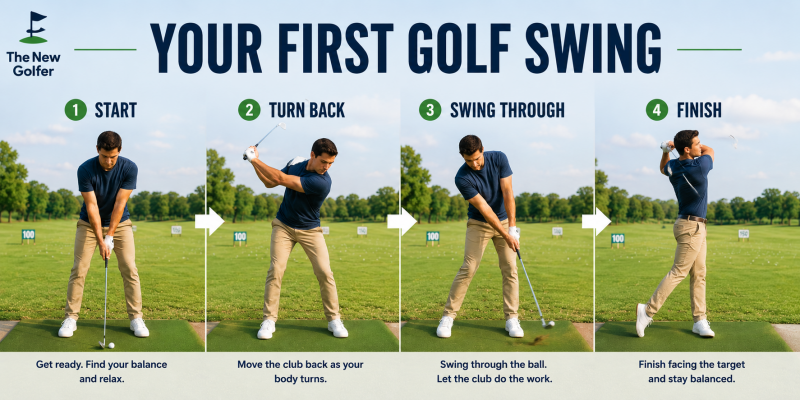
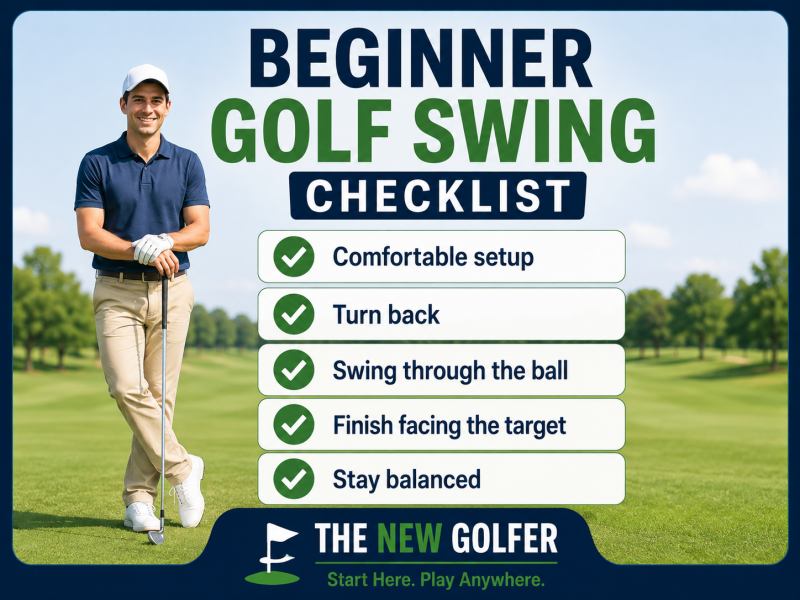
For your first golf swing, concentrate on just four things:
- Start balanced.
- Turn the club back.
- Swing through the ball.
- Finish balanced.
Your first goal isn't distance.
It's simply making a smooth swing and getting the club to meet the ball.
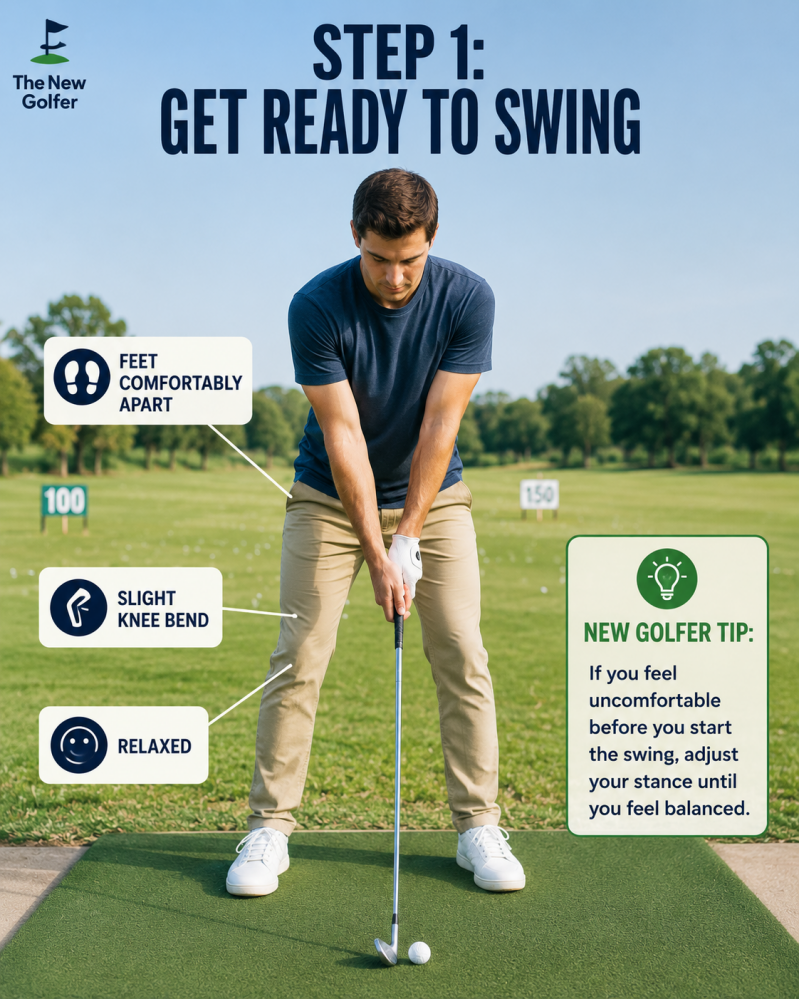
Step 1: Get Ready to Swing
Before you swing, get comfortable.
Stand with your feet roughly shoulder-width apart, bend slightly from your hips and knees and let your arms hang naturally toward the club.
You should feel athletic, comfortable and balanced.
Don't worry about getting every angle perfect.
Step 2: Turn Back
Start the swing by moving the club away from the ball while your upper body turns.
Your arms and body should move together.
Keep turning until the club is comfortably behind you.
Keep your head still and your eye on the ball the whole time
You don't need a huge backswing.
A shorter, controlled backswing is perfectly fine when you're learning.

Step 3: Swing Through — Don't Hit At It
Now let the club change direction and swing back toward the ball.
One of the biggest mistakes new golfers make is trying to smash the ball with their hands.
Instead, think:
Swing the club through the ball.
The golf ball simply gets in the way of the swing.
Let your body start turning toward the target as the club comes through.
You don't need to swing hard.

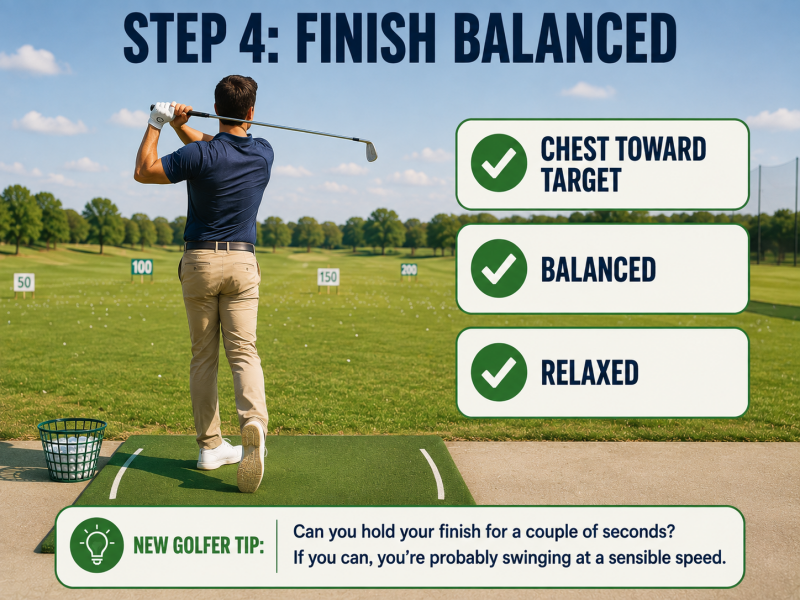
Step 4: Finish Facing the Target
Keep turning after you hit the ball.
At the end of the swing, your body should have turned toward where you want the ball to go.
You should be able to stand comfortably in your finishing position.
If you're falling over or become unbalanced, you've probably tried to swing too hard.
Now Try This at the Driving Range
Don't start by trying to smash your driver.
Take a comfortable iron such as a 7-iron or 8-iron.
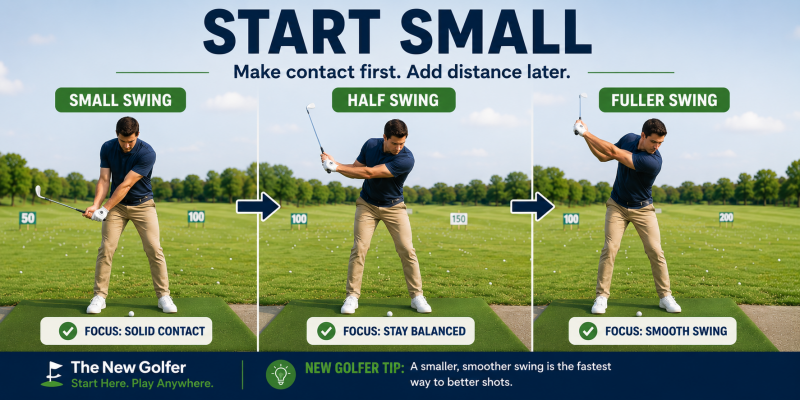
Start with small swings.
Hit a few balls using about half of your normal swing.
Then gradually make the swing a little bigger.
Concentrate on:
Smooth swing → make contact → balanced finish.
You Don't Need to Think About These Yet
- Swing plane
- Wrist angles
- Lag
- Hip clearance
- Compression
- Clubhead speed
- Shot shaping
- Perfect positions
There will be plenty of time to improve your golf swing later.
Right now, learn to make a comfortable, repeatable movement.
Four Things to Avoid
Trying to hit the ball as hard as possible
- Speed can come later.
Making an enormous backswing
- A shorter swing is much easier to control.
Stopping when you hit the ball
- Keep swinging through.
Trying to remember ten swing thoughts
- Pick a simple thought:
Head Still, Swing Through and Balanced finish.
NEXT LESSON → Driving Range For the First Time Lesson #4

Add comment
Comments